
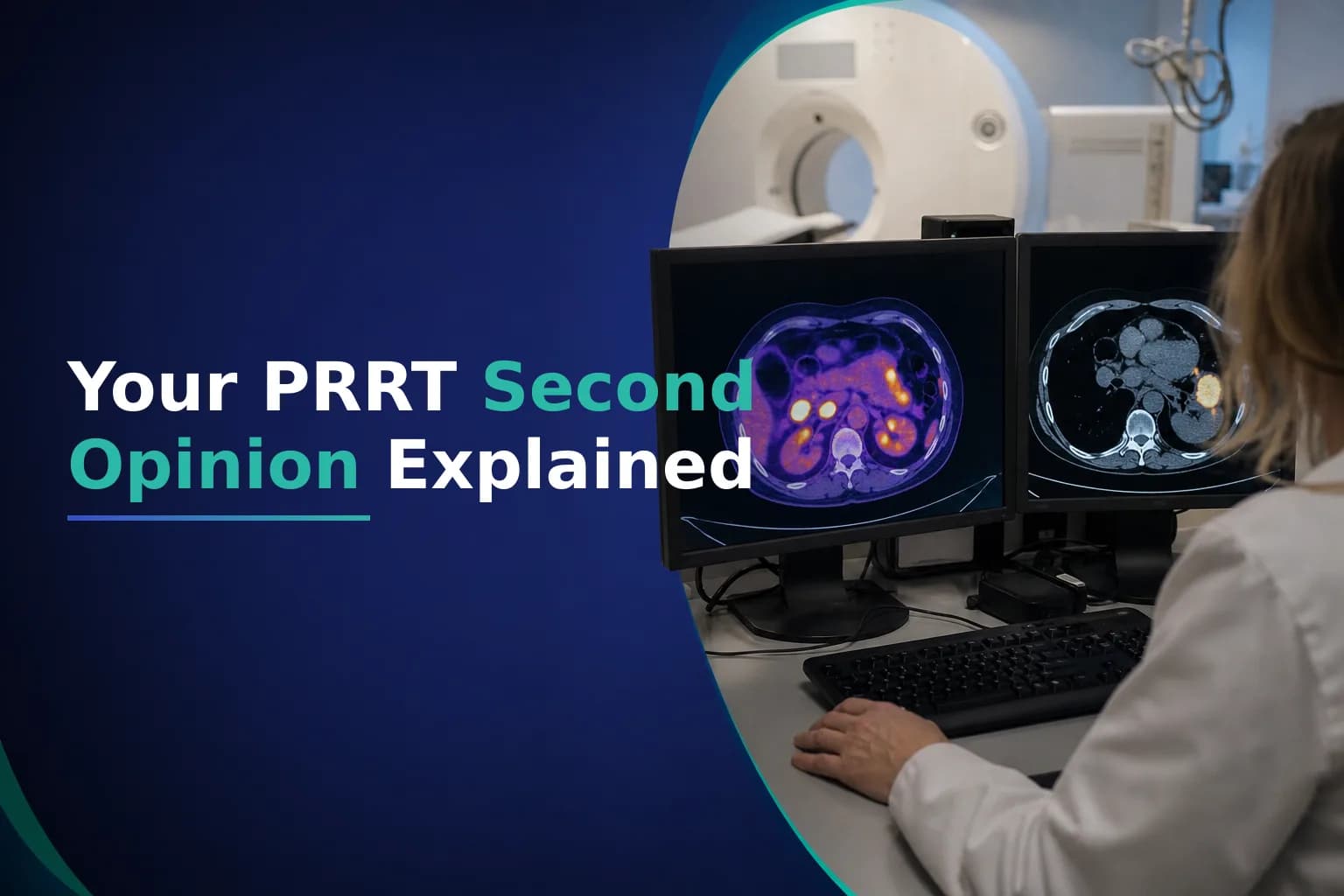
This article covers the DOTATATE track - lutetium Lu-177 dotatate therapy (brand name Lutathera) for gastroenteropancreatic neuroendocrine tumors, or GEP-NETs. If your diagnosis is a midgut NET, pancreatic NET, carcinoid tumor, or another GEP-NET type, this article is for you. If your diagnosis is prostate cancer, a different section of this site covers the PSMA track.
You have a neuroendocrine tumor. Your oncologist has mentioned PRRT - peptide receptor radionuclide therapy - as a possible next step. Or maybe they said you do not qualify. Either way raises questions. A second opinion from a nuclear-medicine team that specializes in GEP-NETs can confirm what your first doctor found, spot a detail they missed, or find treatment options your first center didn't offer.
This article explains which documents and scans to send, what the reviewing team looks at, and when a second opinion changes your treatment plan.
What should you send for a PRRT second opinion?
- Your Ga-68 DOTATATE PET/CT scan - the imaging study that shows whether your tumor cells carry somatostatin receptors on their surface
- Your pathology report - includes tumor grade and the Ki-67 index, which measures how quickly cells divide
- Recent CT or MRI scans - ideally from the past six months
- Blood test results - kidney function (creatinine and GFR), full blood count, and liver enzyme levels
- A treatment summary - what you have already received, including somatostatin analogues such as octreotide or lanreotide, chemotherapy, or surgery
- Your referring team's notes - any records explaining why PRRT was recommended or why your team recommended against it
Why does a second opinion matter for GEP-NET patients?
PRRT with lutetium Lu-177 dotatate is a specialized therapy. Not every oncology center has much experience with it. The decision about who is eligible depends on several factors - scan interpretation, tumor grading, organ-function thresholds, and treatment sequencing. Different specialists may reach different conclusions when they review the same case.
The National Cancer Institute reports that the FDA approval of lutetium Lu-177 dotatate was based on the NETTER-1 phase III trial, which included patients with somatostatin receptor-positive midgut NETs that had progressed on standard-dose octreotide. The trial showed longer progression-free survival compared to high-dose octreotide alone. But eligibility involves more than a positive scan, and cutoffs can vary between centers.
Specialist NET centers typically use a multidisciplinary team - a nuclear-medicine physician, a medical oncologist, and a surgeon or gastroenterologist - who review the same case together. If your first evaluation was done without this kind of team, a second opinion from a dedicated NET program can offer a different viewpoint.
What does the Ga-68 DOTATATE PET scan show?
The Ga-68 DOTATATE PET/CT scan - also called an SSTR-PET scan - is the most important scan for deciding PRRT eligibility. It shows whether your tumor cells carry somatostatin receptors. Lutetium Lu-177 dotatate binds to those receptors and delivers targeted radiation directly to tumor tissue.
The Neuroendocrine Tumor Research Foundation explains that Ga-68 DOTATATE PET is more sensitive than older octreotide scintigraphy scans and is now preferred for checking somatostatin receptor levels in NETs. If your eligibility was assessed using an older OctreoScan instead of a Ga-68 DOTATATE PET, that difference alone might mean you should get a fresh evaluation.
What a reviewing team looks for in your scan:
- Uptake level in the tumor - described using a Krenning score (0 to 4) or a standardized uptake value relative to normal liver tissue. Most PRRT programs require tumor uptake to be at least equal to liver uptake, which corresponds to a Krenning score of 2 or higher.
- Whether all known disease sites are SSTR-positive - if some lesions show strong receptor expression and others show little or none, the team considers whether PRRT will reach all your cancer
- Scan date - scans older than six months may need to be redone, since tumors can lose receptor expression over time
For a detailed guide to how the Ga-68 DOTATATE scan is read and how it drives the eligibility decision, see our article on how Ga-68 DOTATATE PET determines your PRRT eligibility.
What does the reviewing team evaluate beyond the scan?
The scan is central, but it is not the whole picture. A review published in Frontiers in Oncology on PRRT indications in GEP-NETs notes that patient selection requires careful assessment of multiple factors together, not receptor positivity alone. Here is what a second-opinion team typically examines:
Tumor grade and the Ki-67 index
Neuroendocrine tumors are graded G1, G2, or G3 based on the Ki-67 index - a measure of how quickly cells divide. G1 tumors typically have a Ki-67 below about 3 percent. G2 tumors fall roughly between 3 and 20 percent. G3 well-differentiated tumors exceed 20 percent. PRRT tends to work best in well-differentiated G1 and G2 tumors, since they usually have more somatostatin receptors. The boundary between G2 and high-G3 is an area where specialist centers may draw the line differently, and a second opinion is especially valuable if your Ki-67 is near that boundary. See also what your NET pathology grade means for PRRT eligibility.
Kidney and bone marrow function
Your kidneys filter out some lutetium Lu-177 dotatate. Before treatment, blood tests confirm that kidney function is adequate to handle the therapy safely. Your white blood cells, red blood cells, and platelets must also meet minimum levels. A second-opinion team may use slightly different cutoffs depending on their protocol, and patients who came close to qualifying at one center may meet the criteria used at a center with more NET experience.
Disease burden and prior treatment history
How much tumor is present, where it has spread, and what treatments you have already tried all matter when doctors decide if PRRT is right for you. Research in BMC Cancer shows that performance status, tumor burden, and prior treatments affect how well lutetium Lu-177 dotatate works. A reviewing team uses your treatment history to decide your next step, not just to confirm your diagnosis.
Whether somatostatin analogues have been tried first
Current guidelines generally suggest PRRT after a trial of somatostatin analogues (SSAs) such as octreotide or lanreotide if your cancer is growing. If you have not yet tried an SSA, some centers will require it before proceeding. Others - in cases of rapid progression - might suggest starting PRRT right away. A second opinion can help clarify which approach is right for you. For a broader view of where PRRT fits among your options, see GEP-NET types and when Lu-177 DOTATATE is the next step.
When does a second opinion change the treatment plan?
A second opinion tends to change the plan in three main ways:
You were told you are eligible, but the second team finds a concern
This can happen if a reviewer notices that your kidneys aren't as strong as the first team thought, that some lesions show low or no somatostatin receptor uptake, or that a higher-priority treatment - such as targeted therapy or surgery for limited disease - you haven't tried yet. In this case, the second opinion may delay or redirect the plan. The goal is to find the right time to start PRRT, not to deny you access to it.
You were told you are not eligible, but the second team disagrees
This is the scenario many patients hope for. It can happen when the first assessment was made at a center with limited NET imaging experience, when an older OctreoScan was used instead of a Ga-68 DOTATATE PET, or when the Ki-67 cutoff was too strict. It can also happen when eligibility thresholds differ between institutions, and a center with stricter criteria says no to someone who would qualify at a center with more NET experience.
Both teams agree PRRT is appropriate but differ on timing
Sometimes both teams confirm that PRRT will help you eventually, but they disagree on when. The second team might recommend more time on SSA therapy before PRRT, or suggest starting sooner because your cancer is growing fast. Timing matters because PRRT tends to work best when your organs are working their best and the tumors are still showing strong receptor expression.
What if neither team recommends PRRT?
If two specialist teams both conclude that PRRT is not the right path - whether because of low receptor expression, weak kidneys or bone marrow, or cancer that probably won't respond - there are still active treatment options to discuss. These may include targeted therapies, chemotherapy combinations, surgery for limited disease, liver treatments if cancer has spread to the liver, or clinical trials of newer agents.
A second opinion is not only about saying yes or no to PRRT. It is about getting all your options from a team that sees lots of NET patients. If you are thinking about getting a second opinion, you can send your scans to the Art of Healing Cancer team for review. Their nuclear-medicine specialists review Ga-68 DOTATATE PET images and pathology remotely, and can advise on whether you are likely to benefit, might benefit, or would be better off with different treatment - and what other options exist.
How do you send your scans for a remote second opinion?
Most specialist centers now accept imaging digitally. A practical approach:
- Ask your hospital for your Ga-68 DOTATATE PET/CT scan as a DICOM file or on a USB drive - the actual image files, not just the written report
- Request a copy of your pathology report and the most recent CT or MRI scan report
- Ask your oncologist for a one-page treatment summary showing what treatments you got, when, and how they worked
- Gather your most recent blood results, including creatinine, GFR, full blood count, and liver enzyme levels
- Send everything together as one organized package - you'll get a faster, more complete answer that way
An initial eligibility review at a specialist center typically takes a few days to a week. You do not need to travel for this step. Travel and treatment planning come later, if you decide to go ahead. You can start the process by using the Lutetium Therapy contact form. If PRRT isn't right for you, they can suggest other options to explore.
When to talk to your doctor
Seek a specialist review if your Ga-68 DOTATATE PET scan is more than six months old and your cancer is growing. Consider a second opinion if your eligibility was assessed using an older octreotide scintigraphy scan instead of a Ga-68 DOTATATE PET, if your tumor grade falls between G2 and G3, or if your initial evaluation was done at a center without a dedicated NET multidisciplinary team. Getting a second opinion before any treatment is always a good idea.
This article is for general information and is not a substitute for medical advice. Always consult your oncologist or care team about your specific situation.
Frequently asked questions
Do I need a new Ga-68 DOTATATE PET scan before getting a second opinion on PRRT?
Not necessarily. If your scan is less than six months old and your disease has not obviously progressed since it was taken, most reviewing teams will work with the existing images. If the scan is older, or if there has been significant disease progression, the second-opinion team may ask you to repeat it before giving a full assessment. They will usually tell you this upfront after an initial look at your records.
Can a PRRT second opinion be done remotely without traveling to a new hospital?
Yes. Most specialist NET centers can review your scan files in DICOM format, your pathology report, and your blood results without you needing to be present in person. The initial eligibility assessment is generally done remotely. Travel comes later - only if you decide to proceed with treatment at that center. A written opinion from the reviewing team is usually provided before any commitment is made.
What is the Krenning score and why does it matter for PRRT eligibility?
The Krenning score is a four-point scale (0 to 4) that describes how much radiotracer a tumor absorbs on a somatostatin receptor scan. A score of 0 means no uptake; a score of 4 means uptake much higher than normal liver tissue. Most PRRT programs require a Krenning score of 2 or higher - meaning at least equal to normal liver uptake - for a patient to be considered eligible. Some programs set the threshold at 3 or higher. A borderline score may be interpreted differently by different specialist centers, which is one reason a second opinion can matter.
My tumor is grade G2 with a Ki-67 of 18 percent. Am I a candidate for PRRT?
G2 NETs with a Ki-67 up to about 20 percent are generally within the range considered for PRRT, especially when somatostatin receptor expression is strong on the Ga-68 DOTATATE PET scan. A Ki-67 of 18 percent is at the higher end of the G2 range, and the full picture - organ function, disease burden, prior therapy, and receptor uptake - all factor into the final decision. A second opinion from a team with high NET volume is worth seeking at this Ki-67 level, because specialist centers may apply the upper threshold somewhat differently.
What if PRRT is not available in my country and my oncologist has recommended chemotherapy instead?
Access to PRRT varies widely by country. In some regions it is not offered at all; in others the waiting list is long or the cost is prohibitive. If your tumor shows strong somatostatin receptor expression and your grade is G1 or G2, exploring treatment at a specialist center in another country may be worth considering. A remote second opinion can confirm whether you are likely to meet eligibility criteria before you commit to the cost and logistics of international travel.