
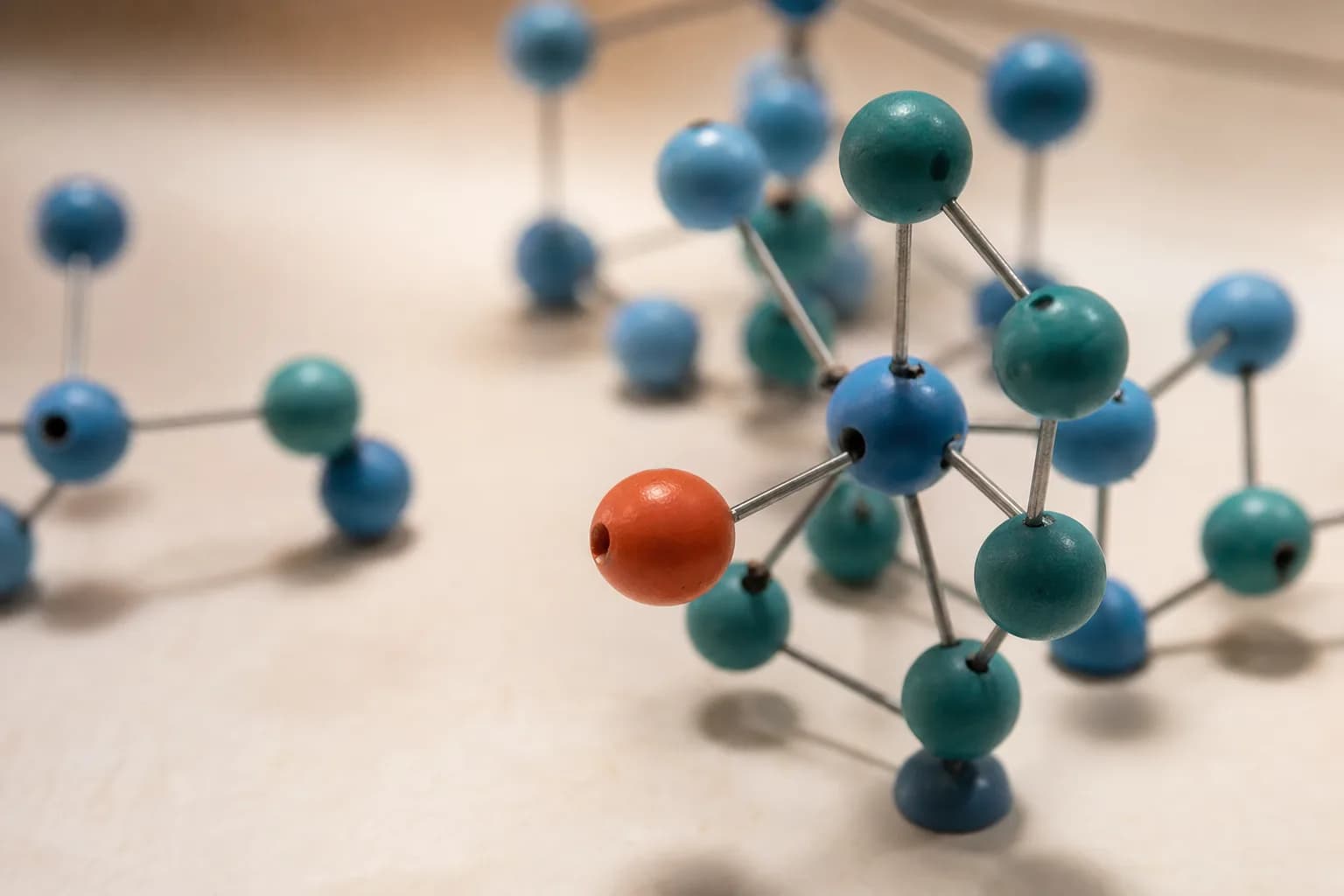
The three pieces of a Lutetium therapy
Every Lu-177 therapy has the same architecture - three components glued together at the molecular level:
1. The targeting molecule (the “finder”)
This is a small protein or peptide engineered to recognize one specific structure on cancer cells:
- For Lu-177 PSMA therapy, the finder is called PSMA-617. It recognizes PSMA (Prostate-Specific Membrane Antigen), a protein that prostate cancer cells produce in massive quantities - far more than any healthy cell does.
- For Lu-177 DOTATATE therapy, the finder is called DOTATATE. It mimics a natural hormone called somatostatin. Most neuroendocrine tumors are studded with somatostatin receptors, which they use for cell signaling.
2. The linker (the “handcuffs”)
A tiny chemical structure called a chelator grips the radioactive atom firmly so it doesn't fall off prematurely. For both Lu-177 PSMA therapy and Lu-177 DOTATATE therapy, this chelator is a molecule called DOTA - a famously stable cage that locks metals in place.
3. The radioactive atom (the “payload”)
Lutetium-177 is a heavy metal isotope that gives off beta particles (electrons) as it decays. The beta particles carry enough energy to damage DNA - but travel only about 2 millimeters before stopping. This short range is the whole reason the therapy works as targeted radiation: the killing happens where the molecule docks, not throughout the body.
Step-by-step: what happens inside your body
Step 1 - The infusion (Day 1, hour 0)
The medicine is given through a regular IV in your arm. It takes about 30 minutes. You feel nothing during the infusion itself. The medicine immediately begins circulating through your bloodstream.
Step 2 - Distribution (Hours 0–4)
Over the next few hours, the targeting molecule binds to cancer cells throughout your body - anywhere they exist. Tumors in your prostate bed, lymph nodes, bones, liver, soft tissue: the molecule finds them all as long as they carry the surface marker.
Some of the medicine is also filtered through your kidneys and bladder for excretion - which is why staying well-hydrated and emptying your bladder often during the first day is important.
Step 3 - Internalization (Hours 4–24)
When the molecule docks with the surface receptor, the cancer cell often pulls the entire complex inside. This is great news for therapy: now the radioactive lutetium is sitting inside the cancer cell, where its short-range radiation can do maximum damage to the cell's DNA.
Step 4 - DNA damage (Days 1–7)
As Lu-177 decays, the beta particles it emits travel about 2 mm - passing through the cancer cell's nucleus and breaking strands of DNA. Cancer cells, which are already mutated and unstable, struggle to repair this damage. They die over the following days and weeks.
Healthy cells nearby that don't express PSMA or somatostatin receptors are largely untouched because the radiation simply doesn't reach them in significant amounts.
Step 5 - Clearance (Days 1–14)
Lu-177 that didn't bind to cancer cells is excreted through your urine over the first few days. By 7–10 days, the vast majority of radioactivity is gone. The remaining tiny amount continues decaying inside the cancer cells where it's still doing its work.
Why is it repeated in cycles?
One dose of Lutetium therapy isn't enough. Cancer cells vary in their receptor density - some cells have many receptors and pick up a lot of medicine, others have fewer. Repeating treatment every 6–8 weeks gives subsequent cycles a chance to reach cells the earlier cycles missed, while allowing your kidneys and bone marrow to recover in between.
Standard protocols:
- Lu-177 PSMA therapy: 6 cycles, 6 weeks apart (total ~7 months)
- Lu-177 DOTATATE therapy: 4 cycles, 8 weeks apart (total ~6 months)
Some patients receive fewer cycles if response is excellent or side effects develop; others may receive additional cycles in specific cases.
Theranostics: the see-then-treat philosophy
Lutetium therapy is part of a broader medical approach called theranostics - combining diagnostics and therapy using the same targeting molecule. The same molecule that delivers radiation can also be paired with a different isotope (Gallium-68 or Fluorine-18) that emits PET-imaging signals.
This means:
- First, you get a diagnostic scan (PSMA PET for prostate, Ga-68 DOTATATE PET for NETs) using the imaging version of the targeting molecule.
- The scan shows whether your cancer cells will pick up the medicine.
- If they do - and they show enough “avidity” - you become a candidate for the therapy.
- If the imaging shows little or no uptake, Lutetium therapy is unlikely to help, and your oncologist will recommend something else.
This is one of the most patient-protective features of Lutetium therapy. Unlike many cancer treatments, we know before we treat whether the therapy is likely to reach your cancer cells.
Safety: how it's designed to spare your healthy tissue
The kidneys
The targeting molecules are small enough that some pass through your kidneys before binding to a tumor. For Lu-177 DOTATATE therapy, an amino acid infusion is given alongside the therapy to protect kidney cells from absorbing the medicine. For Lu-177 PSMA therapy, hydration and renal-protective protocols are standard.
The bone marrow
Some radiation reaches the bone marrow because PSMA-expressing or somatostatin receptor-expressing tumor cells often metastasize to bones. Blood counts (red cells, white cells, platelets) are monitored before each cycle. Mild dips are common; serious dips occur in a small percentage of patients.
The salivary glands
(Lu-177 PSMA therapy only.) Salivary glands naturally express some PSMA, so they pick up small amounts of the medicine. This causes dry mouth - the most common side effect - usually mild and temporary. Cold packs and salivary stimulation during infusion can reduce this.
The bladder
The medicine is excreted in urine, so urine is briefly radioactive. Frequent urination and good hydration in the first 24 hours minimize bladder exposure.
What happens to the radiation after?
By 7–10 days after each infusion, more than 95% of the lutetium has either delivered its radiation to cancer cells or been excreted in urine. The very small amount remaining continues decaying in place. After about 6 weeks (10 half-lives), radioactivity has effectively dropped to baseline levels.
Frequently asked questions
If the radiation is so short-range, how does it reach the DNA?
Once the targeting molecule docks with a cancer cell's surface receptor, the cell often pulls the entire complex inside. The Lu-177 ends up inside the cell, sometimes near the nucleus - and 2 mm is plenty to reach DNA from there.
Will the radiation make me radioactive forever?
No. Lu-177 has a 6.7-day half-life and is rapidly excreted in urine. Most radioactivity is gone within 7–10 days. After 6 weeks, radiation levels are back to baseline.
Can the same targeting molecule be paired with stronger radiation?
Yes - this is the frontier of theranostics research. Actinium-225 is a stronger alpha-emitting isotope being studied in trials with the same PSMA-617 and DOTATATE molecules, with promising early results for patients whose cancer didn't respond to Lu-177.
Is it possible for healthy cells to express the target?
Yes, but always at much lower levels than cancer cells. Healthy prostate tissue expresses some PSMA (this is why Lu-177 PSMA therapy is only used in metastatic disease). Healthy small intestine and pancreas have some somatostatin receptors. The radiation dose to these tissues is calculated to stay well below harmful thresholds.
How do they know the medicine reached my cancer?
After your first cycle (sometimes after later cycles too), a SPECT scan can be performed to visualize where the Lu-177 went. This is your real-time confirmation that the medicine localized in your tumors.