
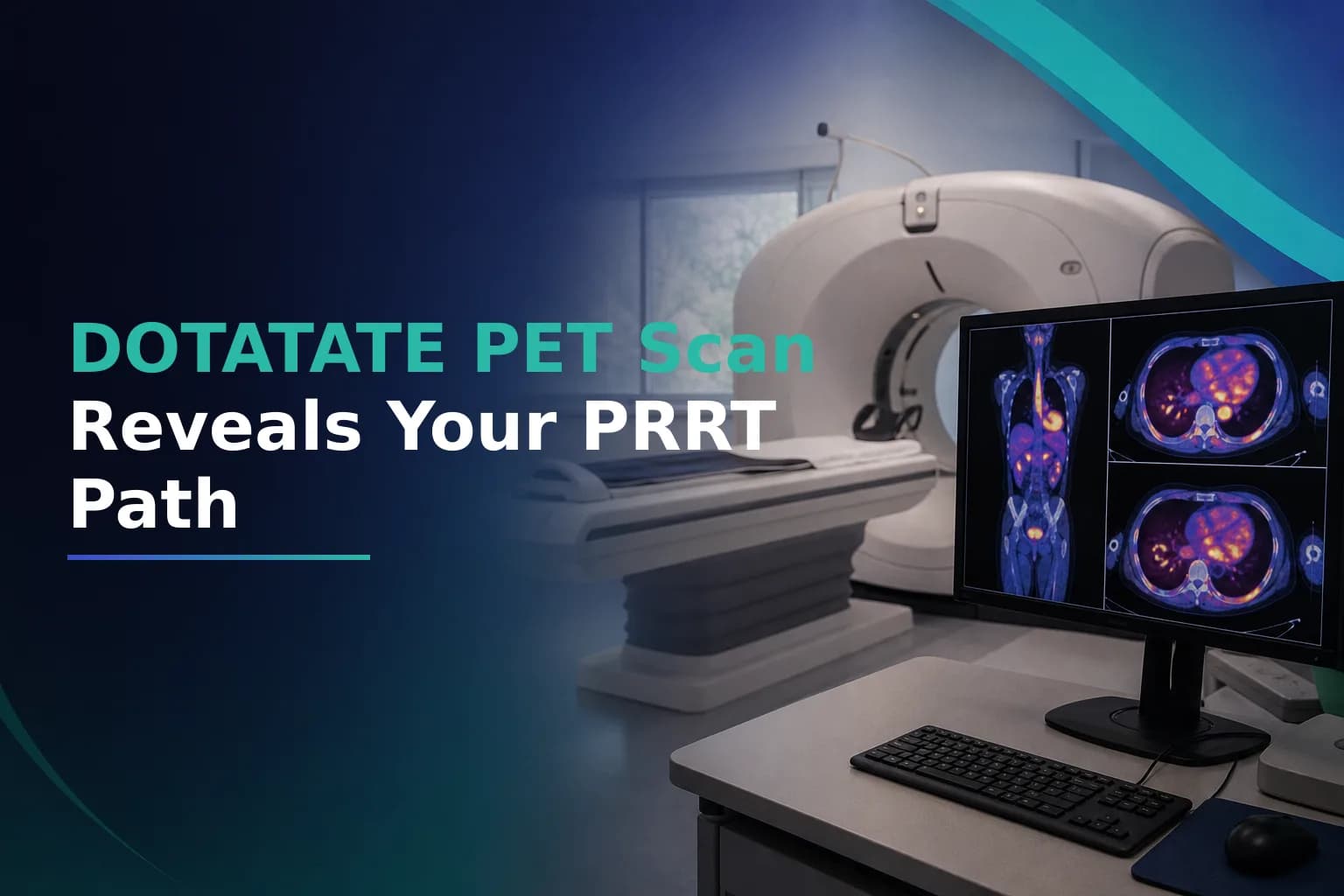
This article is on the DOTATATE track - for patients with gastroenteropancreatic neuroendocrine tumors (GEP-NETs) and their families. If your oncologist has mentioned a scan called Ga-68 DOTATATE PET - or somatostatin receptor imaging - this article explains what it is, what the results mean, and how the scan determines whether you could receive lutetium Lu 177 dotatate therapy, also called PRRT (peptide receptor radionuclide therapy). The scan answers one key question: do your tumor cells carry enough of a specific surface protein - called a somatostatin receptor - to let the PRRT drug find and treat them? That answer affects everything that follows in your treatment plan.
What Is a Gastroenteropancreatic Neuroendocrine Tumor?
Neuroendocrine tumors grow from cells that have features of both nerve cells and hormone-producing glands. GEP-NETs most often develop in the pancreas, small intestine, stomach, appendix, colon, or rectum. Some grow slowly at first, but others spread to the liver, lymph nodes, and bones before doctors find them.
Once the tumor spreads, surgery usually cannot cure it. PRRT is designed to reach cancer cells wherever they have spread in the body - but only if those cells carry a specific surface protein called a somatostatin receptor. Without that receptor, the drug cannot work.
What Are Somatostatin Receptors - and Why Do They Matter for PRRT?
Somatostatin receptors are proteins on the outer surface of many cells. Normal cells have them, but neuroendocrine tumor cells have many more. About 70 to 90 percent of neuroendocrine tumors carry these receptors.
Tumors with many of these receptors are called somatostatin receptor-positive. Tumors without them are receptor-negative. Lutetium Lu 177 dotatate works by attaching a radioactive molecule to a somatostatin analog - a compound designed to seek out these receptors - and delivering radiation directly to cells that carry them. If the receptors are not present in large enough numbers, the drug cannot reach the tumor.
This is the idea behind theranostics - the same molecule used for imaging is also used for treatment. The diagnostic scan and the therapy use the same docking system, so the scan shows you how the drug would work in your body. For more details about how Lu-177 DOTATATE works, see this overview of how Lu-177 DOTATATE works and targets somatostatin receptors.
What Is Somatostatin Receptor Imaging?
Somatostatin receptor imaging is a nuclear medicine scan that maps where somatostatin receptors are active in your body. A technician injects a small amount of a radiotracer into your vein. This radiotracer binds to the receptors. The scanner detects where the tracer has concentrated and produces a detailed image of every location where cells carrying receptors are found.
The standard scan is the Ga-68 DOTATATE PET/CT. It combines two technologies: a positron emission tomography (PET) camera and a computed tomography (CT) scanner. Together they produce two types of images in one session - one showing receptor activity and one showing tissue structure.
The tracer has two parts. The first is gallium-68, a radioactive element that releases positrons and allows the PET camera to detect it. The second is DOTATATE, a synthetic somatostatin analog that binds to somatostatin receptors on tumor cells. When injected, this compound travels through your bloodstream, finds cells with receptors, and locks onto them - creating bright spots wherever those cells are located.
How Does the Ga-68 DOTATATE PET Scan Compare to the Older OctreoScan?
Before the Ga-68 DOTATATE PET/CT became standard, most centers used an older scan called an OctreoScan - formally called indium-111 pentetreotide scintigraphy. The OctreoScan can detect somatostatin receptor-positive tumors, but it takes two to three days to complete, delivers more radiation to the patient, and produces lower-resolution images than modern PET technology.
The Ga-68 DOTATATE PET/CT is faster, sharper, and better at detecting small tumors. This scan finds small tumors that older methods often missed and provides more detail from a single imaging session. For this reason, most PRRT centers now require a recent Ga-68 DOTATATE PET/CT - not an OctreoScan - to determine if you are eligible for treatment.
Gallium Ga 68 dotatate, marketed as NETSPOT, received U.S. FDA approval in 2016 for PET imaging of somatostatin receptor-positive neuroendocrine tumors in adults and children. That approval gave PRRT centers a reliable, standardized imaging tool for confirming receptor status before treatment.
How the NETTER-1 Trial Shaped Current Eligibility Standards
The evidence for PRRT comes largely from the NETTER-1 trial - an international phase III study in 229 patients with progressive, well-differentiated midgut neuroendocrine tumors. The trial showed that lutetium Lu 177 dotatate significantly improved progression-free survival compared with high-dose octreotide alone in somatostatin receptor-positive patients.
One requirement in NETTER-1 was that tumor uptake be greater than liver background on somatostatin receptor imaging before enrollment. This threshold is now the standard imaging requirement for PRRT eligibility at most centers worldwide.
The National Cancer Institute described the FDA approval of lutetium Lu 177 dotatate as a landmark for GEP-NET patients who had progressed on standard therapy. The FDA formally approved Lutathera in January 2018 for somatostatin receptor-positive GEP-NETs in adults based on NETTER-1 data. A separate approval for children aged 12 and older followed in 2024.
What Happens on the Day of Your Scan?
The process is straightforward. You arrive at the nuclear medicine department. A nurse places a small IV in your arm. The technician injects the Ga-68 DOTATATE solution. You wait 45 to 90 minutes for it to travel through your bloodstream and bind to cells with receptors. After that waiting period, you lie still in the PET/CT scanner for about 20 to 40 minutes.
The scan is not painful and makes no loud noise like an MRI does. Most patients say it feels similar to a standard CT scan. You will be mildly radioactive for a few hours afterward, but the amount of radiation used in diagnostic imaging is safe for you and people nearby.
One important note: if you take a somatostatin analog such as octreotide LAR or lanreotide, your care team will time the scan carefully around your injection schedule. These medications compete with the DOTATATE tracer for the same receptors. If you took a long-acting dose recently, it can reduce how much tracer binds to tumor cells and affect the accuracy of the images. Your nuclear medicine team will give you a specific preparation checklist for your situation.
How Radiologists Grade Your Results: The Krenning Scale
When your scan images are ready, a nuclear medicine specialist measures how intensely the tracer has concentrated in your tumors compared to a reference organ - usually the liver. Doctors use the liver as a reference because it has moderate somatostatin receptor expression under normal conditions.
The standard grading tool is the Krenning scale. It runs from 0 to 4. The scale works like this:
- Score 0 - no tracer uptake visible in the tumor
- Score 1 - uptake less than the liver
- Score 2 - uptake equal to the liver
- Score 3 - uptake greater than the liver
- Score 4 - uptake greater than the spleen, which has very high natural receptor density
In clinical practice, PRRT centers look for a score of 3 or 4 when confirming receptor-positive status. The NETTER-1 trial required tumor uptake greater than the liver - a Krenning score of 3 or higher - as a requirement for enrollment and treatment.
Does a High Score Mean You Will Definitely Get PRRT?
Not automatically. A score of 3 or 4 means you meet one requirement, but doctors will check other things too.
Your oncology and nuclear medicine team will also assess:
- Kidney function - because lutetium Lu 177 dotatate is cleared through the kidneys and kidney protection is a standard part of the infusion protocol
- Bone marrow reserve - checked through blood counts, since PRRT can affect blood cell production over multiple cycles
- Performance status - a clinical measure of how well you can carry out daily activities
- Tumor grade - PRRT works best in well-differentiated grade 1 or grade 2 neuroendocrine tumors; higher-grade tumors are less likely to be strongly receptor-positive or to respond well
- Prior treatment history - whether you have been on somatostatin analogs and whether your disease has continued to progress despite them
If you are preparing for that eligibility conversation, reading about what happens during a first PRRT consultation and eligibility evaluation can help you understand what pathology reports, scan images, and blood results to bring to your appointment.
What If Your Scan Is Negative or Shows Low Uptake?
A Krenning score of 0 or 1 means the tumors show little or no detectable somatostatin receptor expression. In that case, PRRT as currently designed may not help you. The drug needs receptors to bind to. When they are absent or sparse, little therapeutic radiation reaches the tumor cells.
Some NET patients get this result - especially those with higher-grade neuroendocrine carcinomas, which are less likely to be strongly receptor-positive. A negative scan does not mean treatment is over. Your oncologist will typically explore other lines of therapy, which may include somatostatin analogs, targeted agents such as everolimus or sunitinib, or systemic chemotherapy, depending on your tumor type, grade, and prior treatment history.
To understand how PRRT fits into the broader GEP-NET treatment sequence and how it compares to somatostatin analogs, see this article on Lu-177 DOTATATE versus somatostatin analogues for GEP-NETs and when to switch.
If you are unsure whether your scan has been interpreted correctly - or if different specialists disagree about your receptor status - sending your images to a team experienced in theranostics is a practical next step. You can send your scans to the Art of Healing Cancer team for review. They specialize in GEP-NET patients considering Lu-177 DOTATATE and can give you a second opinion on your imaging before you decide on any treatment pathway.
What If Only Some of Your Tumors Show High Uptake?
Neuroendocrine tumors can behave differently in different parts of the body. One liver deposit may show a Krenning score of 4 while a nearby lymph node deposit shows a score of 2. This pattern is called heterogeneous uptake.
Mixed uptake patterns may affect how well PRRT works overall, since tumors with fewer receptors may not respond as strongly to targeted radiation as tumors with many receptors. Your oncologist may consider this in the treatment plan - sometimes looking at whether PRRT can be combined with another treatment that better addresses low-uptake disease. Your doctors review the full pattern of uptake across all visible lesions, not just the strongest spot, when making an eligibility decision.
The Scan Also Stages the Full Extent of Your Disease
Beyond eligibility assessment, the Ga-68 DOTATATE PET/CT does something a standard CT or MRI cannot: it finds receptor-positive tumors that are too small for standard imaging to detect.
Small liver deposits, mesenteric lymph nodes, and bone sites that have receptors can all be detected with greater sensitivity on this scan. Knowing the full extent of your disease helps your team plan how many PRRT cycles may be needed, whether any additional treatments should be given with PRRT, and how likely you are to respond well overall.
This staging detail also matters if you plan to seek PRRT abroad. When traveling for treatment - including to India, where PRRT may be more accessible or more affordable than in many home countries - your treating center will want to review the complete scan alongside your pathology records and clinical history before confirming a treatment plan.
Practical Steps Once You Have Your Scan Report
Once you have your Ga-68 DOTATATE PET/CT report, ask your oncologist or nuclear medicine specialist these questions:
- What was my Krenning score or uptake grade for each lesion?
- Did all my lesions show uptake, or only some?
- Is my uptake sufficient to support a PRRT eligibility review?
- Did the scan find disease not visible on my prior CT or MRI?
- If I am on somatostatin analogs, was the scan timed correctly for maximum accuracy?
If you are considering PRRT at a center abroad, you can often have your eligibility reviewed remotely before you travel. Bring or send your digital scan files - in DICOM format if possible - along with the written radiology report and your tumor pathology results. A teleconsultation can often determine whether you are likely to qualify based on this documentation alone, saving you time and cost before committing to travel.
You can submit your scan and clinical history through the contact form at lutetium-therapy.com/contact to request a PRRT eligibility review. If lutetium Lu 177 dotatate is not the right next step for your case, the review will also include an opinion on what alternative treatments might help and are worth discussing with your oncologist.
When to Talk to Your Doctor
Talk to your oncologist or nuclear medicine specialist if:
- You have a confirmed GEP-NET diagnosis and have never had a Ga-68 DOTATATE PET/CT scan
- Your most recent somatostatin receptor scan was an older OctreoScan and your disease has changed since then
- You received a scan report but were not clearly told what the uptake score means for your treatment options
- You are exploring PRRT and want to understand whether your imaging results support eligibility
- Your current team is not experienced with PRRT and you want a second opinion from a dedicated nuclear medicine unit
This article is for general information and is not a substitute for medical advice. Always consult your oncologist or care team about your specific situation.
Frequently asked questions
Does a positive Ga-68 DOTATATE PET scan guarantee that I can have PRRT?
No. A high uptake score on the scan - usually a Krenning score of 3 or 4 - confirms that your tumors carry enough somatostatin receptors to make PRRT technically possible. But other factors are also reviewed before treatment is approved, including kidney function, bone marrow health, tumor grade, and overall performance status. A specialist team will look at all of these together before giving a final recommendation.
I am currently on octreotide LAR. Do I need to stop it before the Ga-68 DOTATATE scan?
Octreotide and other long-acting somatostatin analogs compete with the Ga-68 DOTATATE tracer for the same receptors. If you are on a long-acting formulation, your care team will usually schedule the scan at a specific point in your injection cycle - often in the week before your next injection is due. Short-acting octreotide is typically paused for a shorter period. Your nuclear medicine team will give you exact preparation instructions based on your schedule.
How is the Ga-68 DOTATATE PET scan different from a standard CT or MRI?
A standard CT or MRI shows the size and shape of tissue. The Ga-68 DOTATATE PET scan shows receptor activity - it lights up cells that carry somatostatin receptors regardless of their size. This means the PET scan can detect small receptor-positive tumor deposits that appear normal or invisible on CT alone. The two scans are usually combined as a PET/CT so your team sees both the functional and the structural picture in a single session.
What does it mean if only some of my tumors show up brightly on the scan?
This is called heterogeneous uptake. Some lesions in the same patient may express high numbers of somatostatin receptors while others express few. Lesions with low uptake may not respond as well to PRRT. Your oncologist will weigh the overall uptake pattern across all lesions when deciding whether PRRT is likely to be beneficial for your case. In some situations, combining PRRT with another treatment modality may be considered for disease that does not light up strongly.
How long is a Ga-68 DOTATATE PET scan result valid for PRRT eligibility purposes?
Most PRRT centers require a scan performed within approximately 3 to 12 months before treatment starts. Neuroendocrine tumors can change over time, and receptor expression can shift as the disease progresses. If your scan is older than that, or if your disease has progressed significantly since the scan was taken, your treating team will typically ask for a repeat scan before confirming your eligibility.
Can I have a Ga-68 DOTATATE PET scan done at home and use the results to access PRRT in India?
Yes, in most cases. The scan can be performed at a nuclear medicine center near you, and the DICOM image files along with the written radiology report can be sent to a PRRT center in India for review ahead of any consultation or travel. Many centers will assess your eligibility remotely based on these documents before you commit to traveling, which can save time and cost.