
Is Lu-177 DOTATATE right for you? Quick eligibility check
Final eligibility is determined by your oncologist or endocrinologist after reviewing your imaging, biomarkers (chromogranin A, 5-HIAA), pathology, and clinical status. Try our decision aid →
How Lu-177 DOTATATE therapy works
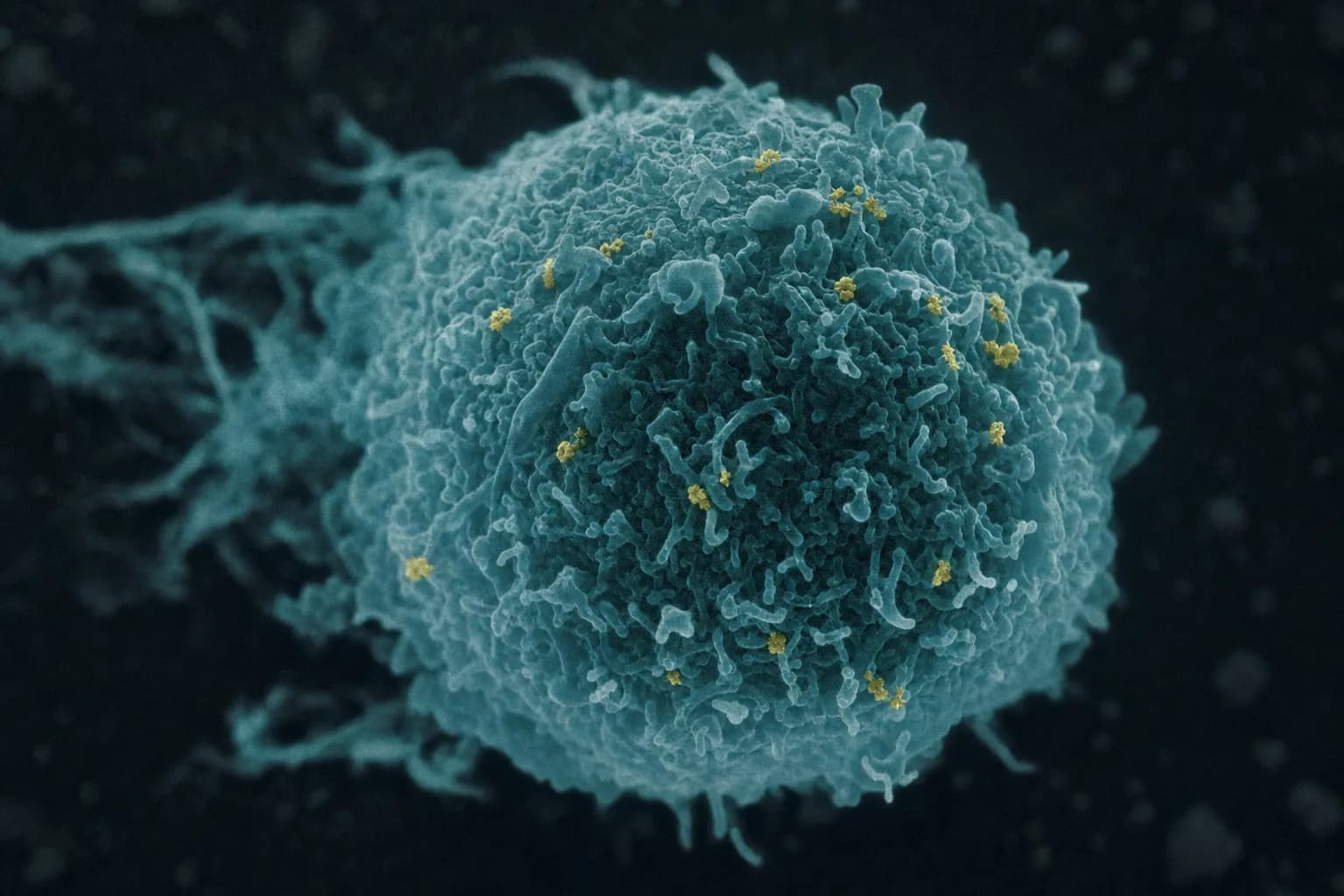
Neuroendocrine tumors are quirky in a useful way: they retain the ability of their healthy parent cells to express somatostatin receptors on their surface. Somatostatin is a natural hormone, and its receptors are normally used by cells to receive signaling messages. NETs often express these receptors at far higher levels than healthy tissue does - making them visible on Ga-68 DOTATATE PET scans, and targetable with Lu-177 DOTATATE.
The therapy is a synthetic peptide called DOTATATE chemically attached to a radioactive atom of Lutetium-177. DOTATATE mimics somatostatin, binding tightly to somatostatin receptors. Once locked on, Lu-177 releases short-range radiation (~2 mm) that destroys the cancer cell's DNA - while sparing nearby healthy tissue.
The clinical evidence: NETTER-1 and NETTER-2
NETTER-1 trial (2017) - the landmark
NETTER-1 was a phase 3 randomized trial of 229 patients with advanced somatostatin-receptor-positive midgut NETs. They received either Lu-177 DOTATATE (studied under the brand Lutathera®) plus octreotide LAR, or high-dose octreotide LAR alone.
NETTER-2 trial (2024) - moving to higher-grade NETs
NETTER-2 studied Lu-177 DOTATATE as first-line therapy in patients with newly diagnosed Grade 2/3 GEP-NETs (higher-grade than NETTER-1). The trial showed that adding this therapy to high-dose octreotide more than tripled progression-free survival compared to high-dose octreotide alone. This is shifting Lu-177 DOTATATE earlier in the disease.
How treatment is given
Frequency and duration
- Number of cycles: 4
- Interval between cycles: 8 weeks
- Total treatment duration: ~6 months
- Each treatment day: ~4 hours total (1 hour amino acid infusion before + 30 min Lu-177 DOTATATE + monitoring)
The amino acid kidney protection
A small amount of Lu-177 DOTATATE is filtered through your kidneys. To protect the kidney tubules from absorbing the medicine, a 4-hour amino acid infusion (typically containing lysine and arginine) is given during and around your Lu-177 DOTATATE infusion. This protocol has been shown to significantly reduce kidney radiation dose without interfering with tumor uptake.
Some patients experience nausea from the amino acid infusion itself - this is the most common reason for discomfort on treatment day. Anti-emetics manage it well.
A typical treatment day
- Arrival (8 AM): Blood tests, vitals, IV placement.
- Amino acid infusion begins (8:30 AM): Slow infusion over 4 hours.
- Lu-177 DOTATATE infusion (9:30 AM): 30-minute infusion, given roughly 30 minutes into the amino acid infusion.
- Amino acid completes (12:30 PM): Hydration continues, frequent urination.
- Discharge (1–2 PM): With written radiation-safety instructions for the next 3–5 days.
Side effects and how they're managed
Very common (more than 1 in 5)
- Nausea - often from the amino acid infusion, manageable with anti-emetics
- Vomiting - less common with modern anti-emetic protocols
- Fatigue - mild to moderate, mostly in the first week after each cycle
- Mild blood count changes - anemia, low platelets, low white cells - monitored before each cycle
Common (5–20%)
- Abdominal discomfort
- Decreased appetite
- Mild hair thinning (very rare to lose hair)
- Temporary worsening of carcinoid symptoms (flushing, diarrhea) - usually transient
Rare but serious
Cost of Lu-177 DOTATATE therapy
The treatment fee covers the complete clinical care - scans, all sessions, amino acid kidney protection infusion, monitoring, post-treatment verification, and local transport between your accommodation in India and our center for every visit. Flights, accommodation, and visa fees are arranged and paid separately.
For patients who would otherwise need years of expensive octreotide LAR injections, Lu-177 DOTATATE can be a powerful long-term value proposition.
Receiving Lu-177 DOTATATE therapy with us
Our dedicated Lu-177 therapy center in India delivers Lu-177 DOTATATE following international protocols (NETTER-1, NETTER-2) at $6,000–$8,000 USD per session. Specialized radioligand therapy practice. In-house radiopharmacy preparing fresh Lu-177 DOTATATE. Multidisciplinary team. Patients from 22+ countries.
Why patients choose us → · Plan your visit →
Frequently asked questions
Is Lu-177 DOTATATE the same as Lutathera?
The active radiopharmaceutical is the same - Lu-177 attached to DOTATATE peptide. Lutathera® is the commercial brand name (Advanced Accelerator Applications, a Novartis company). Many Indian centers prepare Lu-177 DOTATATE in their own in-house hot labs rather than importing the branded product. Clinically equivalent, significantly more affordable.
What can Lu-177 DOTATATE realistically do for NETs?
For patients whose tumors are responding, this therapy can stabilize disease for years - substantially longer than other treatments. Many patients also see meaningful tumor shrinkage. Outcomes vary by NET subtype and individual biology.
How do I know my NET expresses somatostatin receptors?
A Ga-68 DOTATATE PET scan (or similar somatostatin receptor scintigraphy) is performed before therapy. If your scan shows clear uptake in your known tumor sites, you're a candidate. About 80% of well-differentiated NETs show good uptake; higher-grade NETs may show less.
Can I continue octreotide while on Lu-177 DOTATATE?
You'll typically stop octreotide LAR a few weeks before each Lu-177 DOTATATE cycle (so it doesn't block the receptors), then resume it after. Short-acting octreotide is permitted for symptom control. Your nuclear medicine team will give you a specific schedule.
Will I lose my hair?
Hair loss is rare with this therapy. Mild hair thinning has been reported in a small percentage of patients. This is very different from chemotherapy.
What if I have carcinoid syndrome - flushing, diarrhea?
Many patients with carcinoid syndrome see improvement in symptoms after this therapy, particularly diarrhea. However, the first cycle can occasionally trigger a temporary worsening or, very rarely, a carcinoid crisis - which is why pre-medication with octreotide is standard.
Can I have Lu-177 DOTATATE for pancreatic NETs (PNETs)?
Yes - this therapy is approved for gastroenteropancreatic NETs, which includes pancreatic NETs. Selection depends on tumor grade and somatostatin receptor expression on imaging.
Can I have Lu-177 DOTATATE for lung NETs?
Lung NETs are not in the original FDA-approved indication, but evidence supports use in carefully selected patients. Discuss with your oncologist; some centers offer it for lung NETs as off-label or trial-based therapy.
What about radiation safety for my family?
For 3–5 days after each cycle, simple precautions apply: keep about 1 meter of distance from young children and pregnant women, sleep separately, use a separate toilet if possible. Most patients can resume normal activities within a week. See our radiation safety guide.
What happens after my 4th cycle?
Follow-up imaging (Ga-68 DOTATATE PET or anatomical scans) every 3–6 months. Most patients see best response by 12 months after treatment ends. Some patients receive additional cycles (re-treatment) years later if tumors progress again.
What if Lu-177 DOTATATE doesn't work for me?
If your tumor progresses despite this therapy, options include cytotoxic chemotherapy (temozolomide-based, FOLFOX), targeted therapies (everolimus, sunitinib), local treatments for liver-dominant disease, or clinical trials. Our navigators can help you think through next steps.
Do I have to do all 4 sessions with you?
No. We offer single sessions, partial courses, and split treatment between our center and your home country. Many international patients prefer to receive a few sessions with us and the rest closer to home - we coordinate detailed records-sharing and protocol notes with your home oncology team so the transition is seamless. Per-session pricing ($6,000–$8,000 USD) applies whether you do one session or all four.