
This article is for men with metastatic castration-resistant prostate cancer (mCRPC) who have been approved for Lu-177 PSMA therapy. The therapy, also known by the brand name Pluvicto, targets prostate-specific membrane antigen (PSMA) - a protein that appears in high amounts on prostate cancer cells. If your first cycle is coming up soon, or if you are weighing whether to travel for treatment, you probably have a simple question: what actually happens on infusion day?
The short answer is that a Lu-177 PSMA infusion looks nothing like a typical chemotherapy session. The actual injection lasts a short time. The radioactive drug then works from inside your body over the following days - while you go home the same afternoon. This article walks you through the process, step by step.
At a glance: eight steps of a Lu-177 PSMA infusion day
- Blood draw and pre-treatment review on the morning of your appointment
- Consent confirmation and radiation safety briefing with the nuclear medicine team
- IV line placed in your arm or the back of your hand
- Infusion of lutetium Lu 177 vipivotide tetraxetan - typically 10 to 30 minutes
- Saline flush through the same IV line to clear residual drug
- One to two hours of observation in the nuclear medicine unit
- Bladder emptied before you leave the department
- Written radiation safety instructions given - you travel home the same day
The days before your infusion
Your nuclear medicine team will tell you how to prepare before each cycle. In general, you don't need to fast overnight for a Lu-177 PSMA infusion. However, the team may ask you to drink extra fluids the day before and the morning of your appointment. Good hydration helps your kidneys process and clear the drug more efficiently.
Bring a list of your current medications to every appointment. Some drugs and supplements can affect the infusion or how the team reads your blood results. Ask your care team about anything you take regularly before you arrive.
Plan to have someone drive you to and from the unit. You won't be sedated, but some patients feel tired in the hours after the infusion. A private vehicle with good ventilation is preferred on treatment day.
When you arrive: pre-treatment checks
When you check in, the nuclear medicine team will draw blood before every cycle. They check your complete blood count (CBC) and kidney function. This matters because Lu-177 PSMA therapy delivers radiation to tumor cells, but some reaches bone marrow and kidneys too. The team needs to confirm both are healthy enough to proceed. If blood counts fall below the safe level, your cycle may be delayed a week or two to allow recovery.
A nuclear medicine physician or specialist nurse will then review your recent results with you and confirm that your planned dose is right for your current health. This is a good time to ask questions about side effects from your last cycle or about the day's process if this is your first infusion.
If you are starting treatment for the first time, your eligibility should be based on a PSMA-PET scan that showed enough PSMA in your tumor sites. You can read more about what those scan results mean in our guide to what your PSMA-PET results mean for Lu-177 eligibility.
Inside the treatment room: what the infusion looks like
The treatment room is a nuclear medicine suite. It is clean, quiet, and smaller than a typical chemotherapy ward. You won't share the room with other patients during treatment.
A nurse or technologist will place an IV line (a small flexible tube) in a vein in your arm or hand. Once the line is in place, saline runs through it briefly to confirm the vein is clear and the IV is working properly.
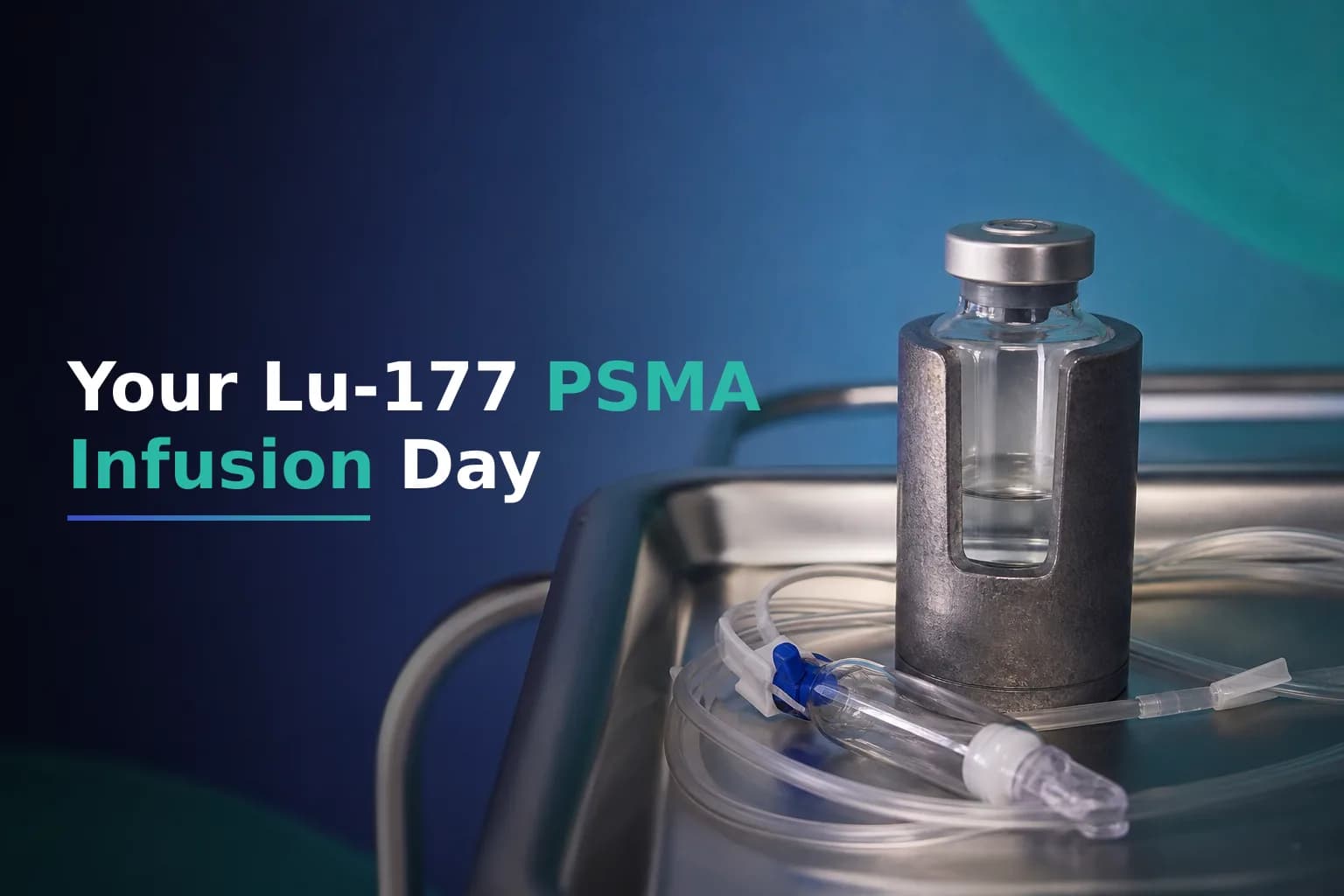
The drug arrives in a lead-shielded container. This shielding protects staff while they handle it - the radiation is real, which is why it kills cancer cells. The container connects to a pump or a closed delivery system, and the drug flows through the IV line into your vein. The actual infusion typically takes between 10 and 30 minutes, according to the Society of Nuclear Medicine and Molecular Imaging (SNMMI).
You should not feel pain during the infusion. Some patients report a cool sensation at the IV site, and a few describe a faint metallic taste during or shortly after. These pass quickly. If you feel anything unusual - tightness in your chest, trouble breathing, or swelling at the IV site - tell the team right away.
Staff may leave the room during part of the infusion or watch you through a window or camera. This is standard radiation safety practice and doesn't mean something is wrong. The team is nearby at all times and can enter the room whenever needed.
When the drug has been delivered, a flush of normal saline runs through the IV line. This clears any residual drug from the tubing and lowers your overall radiation exposure. The FDA prescribing information for Pluvicto lists this saline flush as a required step in the administration process.
After the infusion: the observation period
You stay in the nuclear medicine unit for roughly one to two hours after the infusion, as outlined in Memorial Sloan Kettering Cancer Center's patient guide to Pluvicto. The team watches for any immediate reactions and checks that you feel well before discharge.
During this time, the nursing team will encourage you to drink water. Your body removes lutetium Lu 177 vipivotide tetraxetan mainly through urine. Drinking fluids speeds this process and lowers the radiation dose to your bladder. You will empty your bladder before leaving the department. This step reduces the time radioactive urine stays in your body and limits exposure to people around you after you go home.
Before you leave, the radiation safety team will explain the precautions to follow at home. You'll also get written instructions to take with you. Read them before you travel - the rules are straightforward but important.
Radiation precautions at home after each cycle
You are not dangerous to be around, but you carry a low level of radioactivity for several days. Simple steps protect the people you live with - especially children and pregnant women, whose tissues are more sensitive to radiation.
The SNMMI and MSKCC patient guidelines recommend the following steps after each infusion:
- Sleep alone for at least four days after treatment.
- Stay at least three feet (roughly an arm's length) from other people for most of the day.
- Avoid close physical contact with children or pregnant people for nine to eleven days.
- When using the toilet, sit down and flush at least twice for the first three days. This reduces surface contamination from radioactive urine.
- Keep your clothes, towels, and bed linen separate from the household laundry for several days.
- Wash your hands thoroughly after using the bathroom.
These restrictions are temporary. Most patients manage them easily with a little planning. If you are traveling home on a long-haul flight between cycles, there are additional considerations around proximity to fellow passengers and time in shared spaces. Our separate guide on how to travel safely between Lu-177 PSMA cycles covers these in detail.
The treatment course: how many cycles and how they are spaced
The standard approved regimen is 7.4 GBq every six weeks, for up to six cycles. The VISION trial (the phase 3 study that led to the FDA approval of lutetium Lu 177 vipivotide tetraxetan) used this schedule. In that trial, patients who received the therapy alongside standard of care lived longer compared with standard of care alone.
Not every patient completes all six cycles. Your oncologist and nuclear medicine physician review your blood counts, kidney function, and scan results before each cycle. If counts are low, the team may delay a cycle. If the treatment isn't working or you're not handling it well, the team may recommend stopping earlier. Some patients complete all six cycles on schedule and respond clearly throughout.
The six-week gap between cycles lets your bone marrow and kidneys recover before you get the next dose of radiation. It's not just waiting time - it's a built-in safety margin.
Monitoring between cycles: blood tests and PSA
Between infusions, your team will monitor your blood counts regularly. A drop in neutrophils or platelets means the team may adjust the timing or dose. Your kidney function is checked the same way. Creatinine and eGFR readings tell the team whether your kidneys are handling the therapy well from one cycle to the next.
Your team measures your PSA before each cycle and in the weeks after. You should know that PSA doesn't always drop right away. Some patients see a rise in PSA after the first or second infusion before it eventually drops - a pattern sometimes called a PSA flare. A rising PSA doesn't prove the treatment failed. Scan results and symptoms matter too. Our detailed guide on reading PSA trends during Lu-177 PSMA therapy explains how to read these numbers and when to worry.
Side effects to expect and when to call your team
The most commonly reported side effects of Lu-177 PSMA therapy include fatigue, dry mouth, nausea, and loss of appetite. These tend to be mild to moderate in most patients, according to the Prostate Cancer Foundation's review of the therapy. They often get better in the days between cycles.
Less commonly, the therapy can reduce bone marrow activity, causing lower counts of red blood cells, white blood cells, or platelets. Some patients have a mild drop in kidney function, particularly after multiple cycles. Your team monitors both closely and can adjust the plan if needed.
Call your care team right away if you develop any of the following between cycles:
- A fever of 38 degrees Celsius (100.4 degrees Fahrenheit) or higher
- Unusual bruising or bleeding
- Bone pain that is significantly worse than your usual level
- Signs of urinary infection - burning, strong odour, or pain when urinating
- Fatigue so severe you struggle to move around or care for yourself
If you have not yet confirmed your eligibility
If you haven't started treatment yet and want to confirm whether Lu-177 PSMA therapy is right for your situation, the most important first step is having your PSMA-PET scan reviewed by a team that specializes in radioligand therapy. You can send your scans to the Art of Healing Cancer team for review before committing to any treatment plan. If Lu-177 turns out not to be the right fit for you, they can also advise on other treatments worth trying.
If you are ready to move forward and want to explore treatment in India, the Lutetium Therapy contact page is where to start. Share your recent scans and blood results, and the team can help you understand what a realistic treatment plan looks like - including cycle scheduling and what to prepare before you travel.
When to talk to your doctor
Talk to your oncologist or nuclear medicine physician before your first infusion if you have questions about your pre-treatment checklist, your current medications, or how to prepare your home for the radiation precaution period. If you notice new or worsening symptoms between cycles - particularly fever, significant bone pain, or unusual bleeding - contact your care team the same day instead of waiting for your next scheduled appointment.
This article is for general information and is not a substitute for medical advice. Always consult your oncologist or care team about your specific situation.
Frequently asked questions
How long does a Lu-177 PSMA infusion take?
The actual injection typically takes between 10 and 30 minutes. After the infusion you stay in the nuclear medicine unit for roughly one to two hours of observation. Most patients are home by mid-afternoon if they arrive early in the morning.
Is a Lu-177 PSMA infusion painful?
The infusion itself is not painful. You will feel the usual brief pinch when the IV line is placed in your arm or hand. During the infusion, some patients notice a mild coolness at the IV site or a faint metallic taste. Both pass quickly. If anything feels wrong, tell the nursing staff immediately.
Do I have to stay in hospital overnight after my Lu-177 PSMA infusion?
In most cases, no. Lu-177 PSMA therapy is given as an outpatient procedure. You are observed for one to two hours after the infusion and then discharged the same day with written radiation safety instructions for home.
How long do I need to follow radiation precautions after my infusion?
The main precautions - sleeping alone, staying three feet from others, sitting when urinating, and keeping laundry separate - apply for approximately four to eleven days after each cycle, depending on your specific guidance. Precautions around small children and pregnant people may last a little longer. Your nuclear medicine team will give you written instructions specific to your situation.
Can I travel home by plane after my Lu-177 PSMA infusion?
Most patients can travel by air after the initial observation period, but the timing depends on how far you are flying and the radiation regulations in your home country. Some countries require a waiting period before flying. Discuss your travel plans with your nuclear medicine team before treatment so they can advise you and provide any documentation you may need at the airport.
What blood tests do I need before each cycle of Lu-177 PSMA therapy?
Your team will check your complete blood count (CBC) and kidney function before every cycle. These tests confirm your bone marrow and kidneys are handling the therapy well enough to proceed. If your counts are below the safe threshold, your next cycle may be delayed by one to two weeks to allow recovery.